


Breadcrumb

UCM Magazine
The University of Central Missouri's Alumni Publication
UCM Magazine is the biannual publication for alumni and friends of the University of Central Missouri. Read feature articles about exciting innovations across UCM's four academic colleges, hear success stories from alumni across generations, see photos from MuleNation alumni events and much more!
If you have news to share, we want to hear from you! If you are a UCM alum with an update on a job, award or achievement from within the past year, submit a Class Note with photo. If you are the proud parent or grandparent of a future Mule or Jenny, share your Baby News.
Do you have a story idea or feedback on the print publication that is mailed to annual donors? Email the editor at ucmmagazine@ucmo.edu.
FEATURED ARTICLES
IBE Means Business
Students Build a Company in Just One Semester
By Trevor McLanahan, ’25, and Nikitha Kishore Avadootha, Computer Science Undergraduate Student
At UCM, the Integrative Business Experience (IBE) stands as one of the most dynamic and transformative educational experiences offered within the Harmon College of Business and Professional Studies. It is known across campus not simply as a set of business classes but as a defining experience — an intense semester-long immersion in the realities of professional work.
At the heart of the experience is team-based learning. Students work in large teams — sometimes 25–30 people — facing real deadlines, real disagreements and real pressure as they make collective decisions that affect their bottom line.
In just 16 weeks, each IBE team forms a company, takes out a loan from Equity Bank, strategizes with volunteer mentors from the community, secures a vendor for the product they envision, markets and sells that product, and selects a nonprofit organization to partner with for a community service project and to receive any net profits at the end of the semester. The program blends academic rigor with real-world responsibility, demanding not only dedication to learning but also emotional investment, teamwork and adaptability.
For students like Riley Robyn, a fall 2025 participant, IBE became the semester where everything she learned started to make sense. For alumni like Matt Houseworth, ’05, ’08, now associate dean of the Harmon College, it is the experience that shaped his professional identity and helped set the stage for a career in higher education. And for longtime faculty such as Professor Emerita Mary McCord, IBE represents the pinnacle of experiential learning — a model of education that prepares students not just for their first job, but for a lifetime of leadership.
Together, their stories paint a vivid portrait of a program that transforms classrooms into companies and students into confident, community-minded leaders.
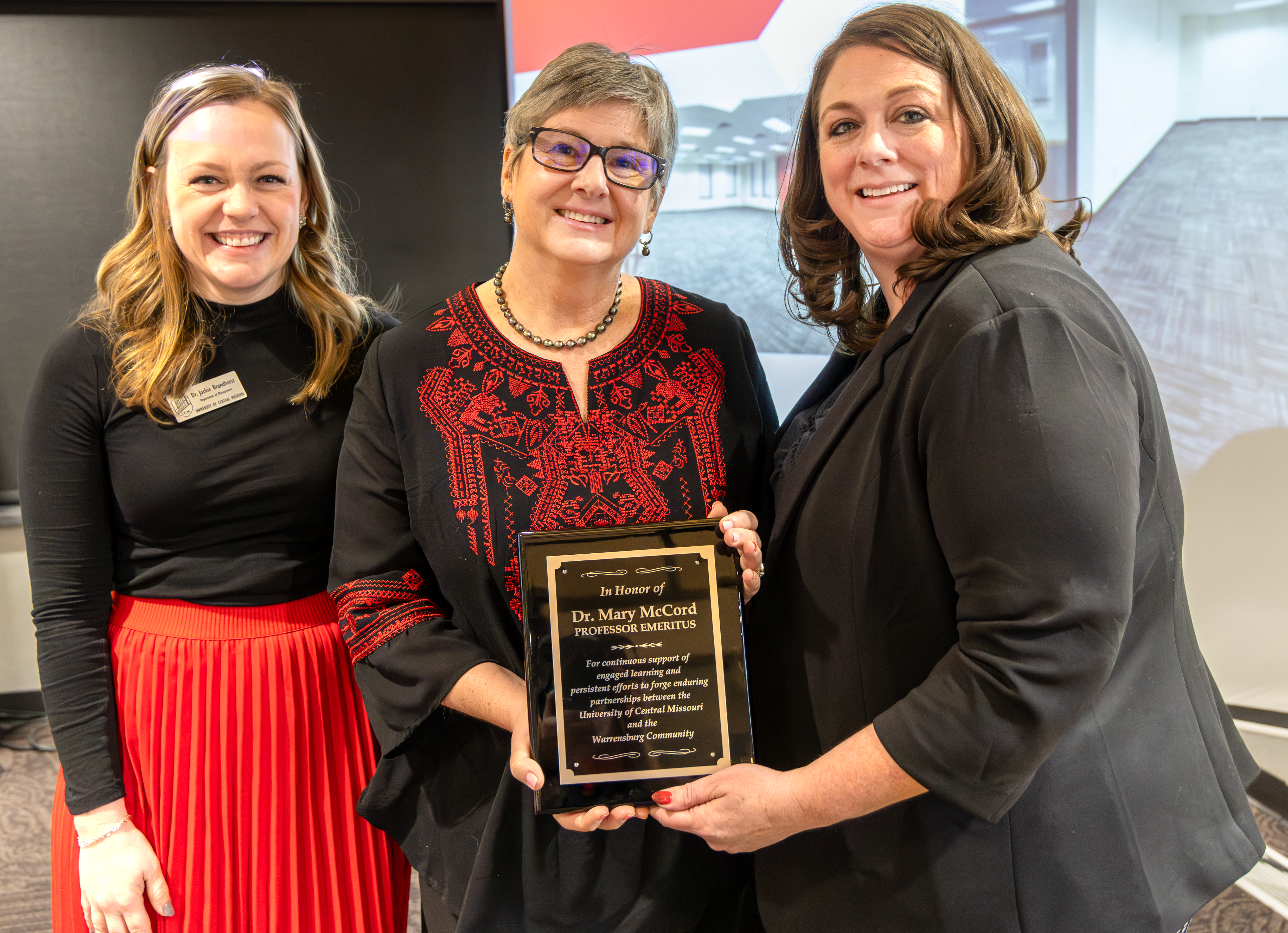
IBE Director Jackie Brandhorst, left, and Department of Management Chair Keira Solon, right, honor Professor Emerita Mary McCord at an event celebrating the program's 100th student-run company.
A Team Effort
The roots of IBE trace back to Mary McCord’s time as a doctoral student in the mid-1990s at the University of Oklahoma (OU) in Norman. There she encountered an innovative approach while earning her Ph.D. in Business Administration.
McCord observed OU Management Professor Larry Michaelsen providing real business problems for students to solve in real time through coordination, communication and collaboration. Trained as an organizational psychologist, Michaelsen spent decades refining structured team-learning methods and became internationally recognized for developing what is now known as team-based learning (TBL). His approach has spread across hundreds of disciplines and institutions worldwide, informed by his own experience with more than a thousand student teams.
After earning her doctorate, McCord joined the faculty at UCM in 1999. A few years later, she invited her former professor to campus to speak about TBL, and the idea was well received. Michaelsen himself joined UCM’s faculty in 2003, and together they began to build the IBE program around this core principle: everything must be team based. Every course in the 12-credit-hour IBE block — management, marketing, finance and the practicum — is interconnected. Students function as teams within a single company, with each department depending on the others to meet deadlines, stay organized and ensure profitability.
“None of the functional units can succeed alone,” explains Department of Management Chair Keira Solon. “They have to talk to each other. They have to depend on each other — that’s the whole point.”
Faculty guide students through concepts, but the responsibility for every decision rests on the business that student teams create from scratch in just one semester.
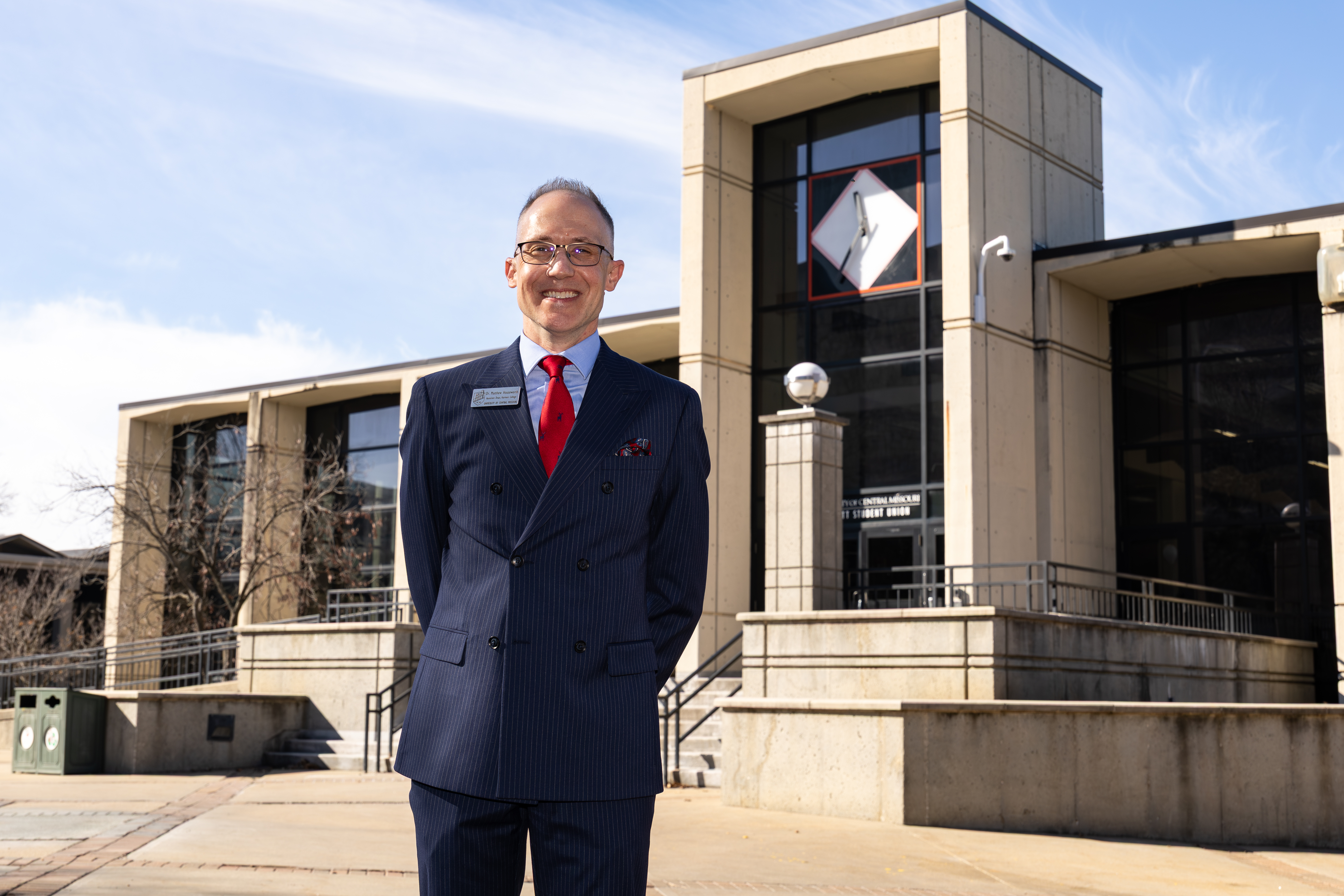
Matt Houseworth, an alumnus of the first IBE cohort in 2004, now serves as associate dean of UCM's Harmon College of Business and Professional Studies.
Concept to Company
Select a project. Research the market. Coordinate with vendors. Sell the inventory. Deliver on promises.
This is the process every team of IBE students experiences when creating their company.
Students have launched more than 100 products since 2004, ranging from CMSU medical
scrubs to Mo the Mule bobbleheads.
In one semester, IBE students are required to create and manage two significant enterprises: an actual startup company and a hands-on community service project. The link between learning and experience occurs because the content is specifically sequenced to support students in organizing and managing their business and service ventures.
McCord often hears from alumni who don’t remember the exams, textbooks or lectures — but always remember their IBE project.
“It isn’t just about business,” she says. “It’s about becoming a citizen in your community.”
Matt Houseworth was one of McCord’s first IBE students at the dawn of the program. Long before he became associate dean of the Harmon College, he was in one of the three companies student teams created in 2004.
Houseworth entered the program as a junior, which remains students’ point of entry today. Expecting traditional lecture-based classes, he quickly found himself immersed in something entirely different.
“Suddenly we went into an experiential, team-based concept where it all came together with a shared purpose,” he recalls. “It lasted the full 16 weeks and not just a couple of weeks like other group projects.”
Taking advantage of a fashion trend at the time, Houseworth’s team selected CMSU-branded medical scrubs as their product. They determined that any profit generated after paying back their bank loan and production costs would benefit the Red Cross and Big Brothers Big Sisters, their nonprofit partners. Excitement was high — until the company faced a major obstacle.
“We found out the vendor couldn’t fulfill our order,” Houseworth remembers. “We had to find another vendor in a pretty quick fashion … it was part of the experience.”
This became a defining team moment. Students scrambled to divide tasks, negotiate new terms and keep morale from dropping. Houseworth saw how essential communication and teamwork were when the pressure was high.
“You figure out your strengths and weaknesses pretty quickly,” he reflects. “You find your fit — leadership, management, sales. And you figure it out by working with people.”
The lessons he learned as a student about collaboration, leadership and confidence have ultimately shaped Houseworth’s career. After earning his bachelor’s degree in Marketing, he went on to earn his MBA at UCM, followed by a Ph.D. from Indiana State University. Now an associate professor of Management, he continues to support and advocate for the program that helped define his professional path.
“This has been the joy of my life the last 20-plus years,” Houseworth says of his time in the Harmon College, starting as a student and continuing as a faculty member. “I owe a lot to those early experiences and especially IBE.”
Bill Bensing, ’09, is another alumnus who credits IBE as a transformative experience that taught him foundational lessons. Bensing was the president of his IBE company, Dry Up Hunger. Their product, UCM-branded beach towels, produced one of the highest IBE net profits to date. The team donated nearly $8,000 to the Johnson County Food Pantry, extending the company’s impact beyond the classroom and into the community.
For Bensing, the value of IBE went far beyond coursework and gave him a competitive advantage when earning his MBA at the EM Strasbourg Business School in France.
“There was an opportunity in IBE that a lot of other people aren’t ever afforded — you have a chance to go out, raise money and build something from scratch,” he explains. “It’s easy to rattle off what you studied, but when you contextually understand what you’re doing, you can be put into different circumstances. Even if you can’t recall what the book said, you have an experience to fall back on.”
Bensing encourages current students to take advantage of the IBE program, which provides an environment to take calculated risks while still at the university.
“A success of IBE,” he says, “is someone walking out of that class thinking, ‘I’m going to go try this now.’”
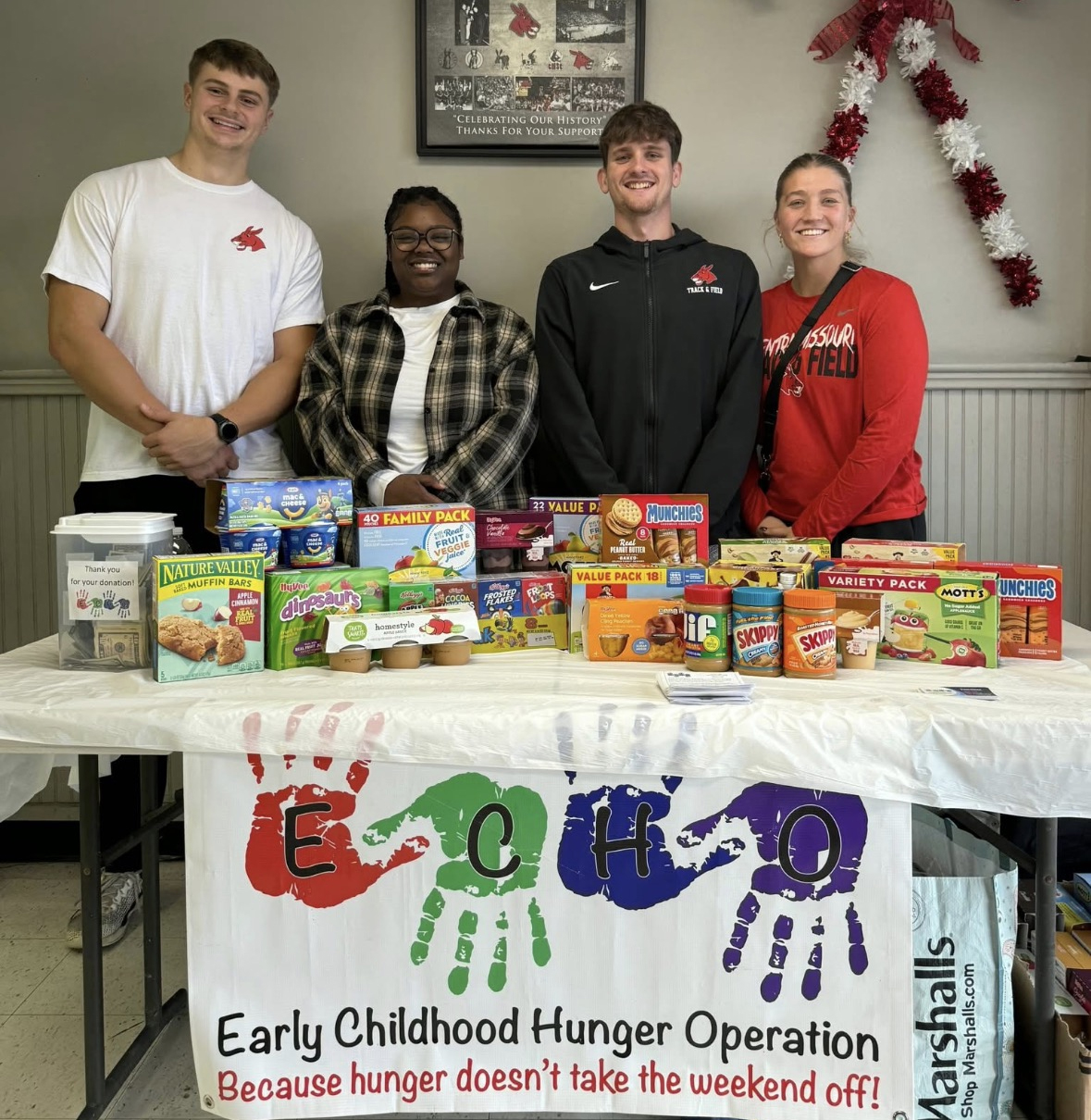
MuleWraps company team members Owen Gish, Meshia Dedner, Clay Pilliard and Karsyn Kanzler host a food drive to benefit their nonprofit partner, ECHO, which provides supplemental food to preschool-age children on weekends.
The Startup Semester
Meshia Dedner and Riley Robyn are both Events Marketing and Management majors who took IBE in the fall of 2025. Their team created MuleWraps stadium blankets, with Dedner serving as the company’s CEO.
“Being a CEO of a company full of people — many different personalities and many different backgrounds — takes a lot,” Dedner reflects. “I’ve learned leadership, communication and patience. … I prefer challenges because they teach me that I can work through things. It shows me I’m capable of doing more.”
Robyn agrees that building a company with her peers helped her develop stronger communication skills, more confidence in her ideas and a deeper understanding of what leadership looks like in practice. Each team member viewed their success as a team accomplishment — a shared challenge and shared victory.
Robyn says she thinks IBE should be required for all students pursuing a Bachelor
of Science in Business Administration, not just those majoring in Management or Events
Marketing and Management. She says the block schedule helped her understand how various
business functions align and how different career paths are interconnected.
“For my major, it’s required,” says Robyn. “But a lot of people do it because academic
advisors have great things to say about it and because students already know what
IBE is just from hearing about it.”
Although IBE is not required for Marketing major Julian Fletcher, he opted to enroll in the program after speaking with professors and his success advisor. Julian oversaw the marketing efforts for Central 13, the team behind the other product that came out of the fall 2025 IBE experience: a UCM-branded bandana.
“Working in teams showed us how important communication really is — whether it was
talking through disagreements with teammates or reaching out to manufacturers,” explains
Fletcher, who serves as president of UCM’s student chapter of the American Marketing
Association. “I think it goes back to team connection, being able to see everyone’s
uniqueness in the company because each person put 100 percent of themselves into it.”
IBE teams divide into functional departments like marketing, finance, operations and sales. They coordinate continually to stay on track.
“The way our team works together makes all the difference,” Robyn says. “You can’t just do your part and disappear — you have to constantly check in with everyone else.”
In a traditional course, students working on a group project could potentially get away with doing the minimum. In IBE, every missed meeting or incomplete task affects the entire company.
“It’s one thing to not go to class,” says Solon, who oversaw the fall 2025 IBE cohort.
“It’s another thing to disappoint 30 of your teammates.”
Team-based learning demands accountability. IBE’s peer evaluations are one of the program’s most defining features, designed to help students grow as collaborators and leaders. Students evaluate one another on initiative, communication, reliability, contribution and teamwork.
“It’s really hard to give substantive feedback, and even harder to accept it,” Solon says. “But, that’s where the growth happens.”
Something shifts by the midpoint of the semester, Solon observes. Students gain confidence, take ownership of their work and begin to advocate for what the team needs.
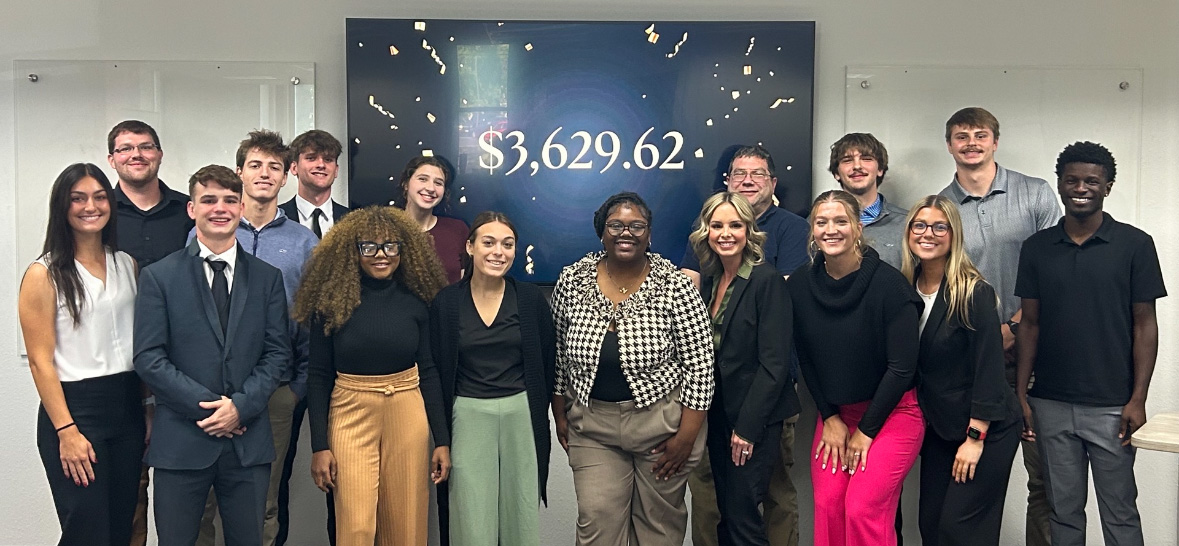
The MuleWraps team celebrates the net profit they were able to donate to ECHO at the end of their IBE semester.
Giving Back
Beyond the business experience, each IBE company must complete at least 100 hours of community service to benefit their chosen nonprofit. The goal is not to “check a box,” but rather to understand how business and service intersect.
Central 13 decided to partner with Warrensburg Main Street, a nonprofit dedicated to working with local businesses to preserve and revitalize the city’s historical downtown.
“We wanted to support the community while also using their events to help us sell our product, and Burg Fest gave us the opportunity to do both,” Julian explains.
The MuleWraps team partnered with the Warrensburg-based Early Childhood Hunger Operation (ECHO) after meeting several nonprofits at a fair early in the semester. ECHO was started in 2010 by a group of students in a combined class of entrepreneurship, taught by McCord, and social work, taught by Associate Professor Marlys Peck. Dedner’s favorite moments have come from seeing the company’s impact in the community.
“We ran a food drive, and the community came out in droves,” she recalls. “Seeing people show up and support — knowing we’re helping the community — was amazing.”
Their efforts are part of a larger legacy.
Over the past 20 years, IBE student-led companies have contributed over $450,000 to more than 70 nonprofits. A total of more than 2,000 students have logged over 30,000 volunteer hours.
Projects have included assisting with recovery efforts after the deadly 2011 tornado in Joplin, Missouri, renovating transitional housing shelters, cleaning up city and state parks, painting murals downtown and volunteering at the Missouri Veterans Home in Warrensburg.
“The community isn’t just part of the program — it’s essential to it,” says Jackie
Brandhorst, an associate professor of Management who has served as director of IBE
for five years. “For me, it’s not just about the creation of a business plan or receiving
a loan; it’s about students going out there and making something meaningful happen.”
As students invest in the community, the community invests in them. Local professionals step in as mentors during the Pursuit Product Summit in the fourth or fifth week of the semester.
Future Ready
As technology reshapes the future of business, IBE remains grounded in human skills: decision-making, communication, leadership and teamwork. Alongside team-based learning, students now use artificial intelligence-powered tools, but not at the expense of critical thinking.
“You can ask ChatGPT what you should do,” Solon jokes, “but, there’s still personal decision-making that’s hard to replicate.”
For Fletcher, the highlight of his IBE semester was learning that business is about people.
“The ability to genuinely connect with somebody, past just surface level and small talk” was what resonated with him. The experience also reinforced for him that he chose the right major and was on the right track for his career.
For more than two decades, the Integrative Business Experience has shaped students into leaders — confident, resilient, service-minded and ready to contribute to their communities. Through the stories of faculty, alumni and current students, the impact of team-based learning becomes clear. IBE challenges students, pushes them and reveals strengths they never knew they had.
Most importantly, it gives them a story — one they remember long after graduation. A story of the product they brought into the world, the nonprofit they supported and the team they became part of. At UCM, IBE is not just a series of courses; it is an experience that shapes character, fuels ambition and prepares students for leadership in every aspect of life.
Are you the owner or manager of a Mule-Powered Business? If you are a UCM alum who is running a company or enterprise, share your story and get a Mule-Powered Business decal to show your UCM pride!
Mule-Powered BusinessA Family Tradition
What Keeps UCM Legacy Families Coming Back
By Jazmin Hohmann, Public Relations Undergraduate Student
It was Bid Day 2017, and freshman Kate Schuler was running through Selmo Park to meet her new sorority sisters. She looked across the street to see her mom beaming at her. Kristina Schuler, ’90, wanted to be part of her daughter’s big day, delighted that Kate was now the newest member of the same sorority she was in as a student, Sigma Sigma Sigma, or Tri Sigma.
“I drove down here, and I was hiding,” admits Kristina, an associate professor of Elementary Education. “I watched the whole thing.”
Kate’s dad, Kurtis Schuler, ’89, was also in Greek Life as a member of the fraternity Alpha Kappa Lambda, and Kristina was AKL’s “little sister.” A little sister is a title given to one female student each year who is considered a close friend and active supporter of the fraternity.
Being the fraternity’s little sister had an immense impact on Kristina’s college experience. The AKLs would often hang out by “the wall” on the east side of the student union — not yet named for President Ed Elliott, who would retire in 1999. Kristina would meet up with her to-be husband and his friends there after class.
Kristina and Kurtis’ son, Kaleb, followed in his father’s footsteps, joining AKL. Kaleb graduated in 2018 with a Bachelor of Science in Business Administration, and Kate earned her degree in Dietetics in 2021. The siblings cherish sharing so many memories with their parents, and Kate especially loves Homecoming. Her enthusiasm for this tradition started as a child when her parents took her and her brother to the parade. When she became a student, she got to experience events like the pep rally, voting for Homecoming royalty, creating parade floats and spirit arches, and going to the Mules Football game with her friends.
“I feel like as a kid you don’t really understand what college is,” says Kate. “But now I see that is where you make good friends, and you can just pick up with them where you left off.”
As a UCM Legacy Family, the Schulers still attend Homecoming every year and have even considered investing in a place to stay that weekend while visiting friends.
For families like the Schulers, UCM is their home away from home, but for others it has been their home since the day they were born.
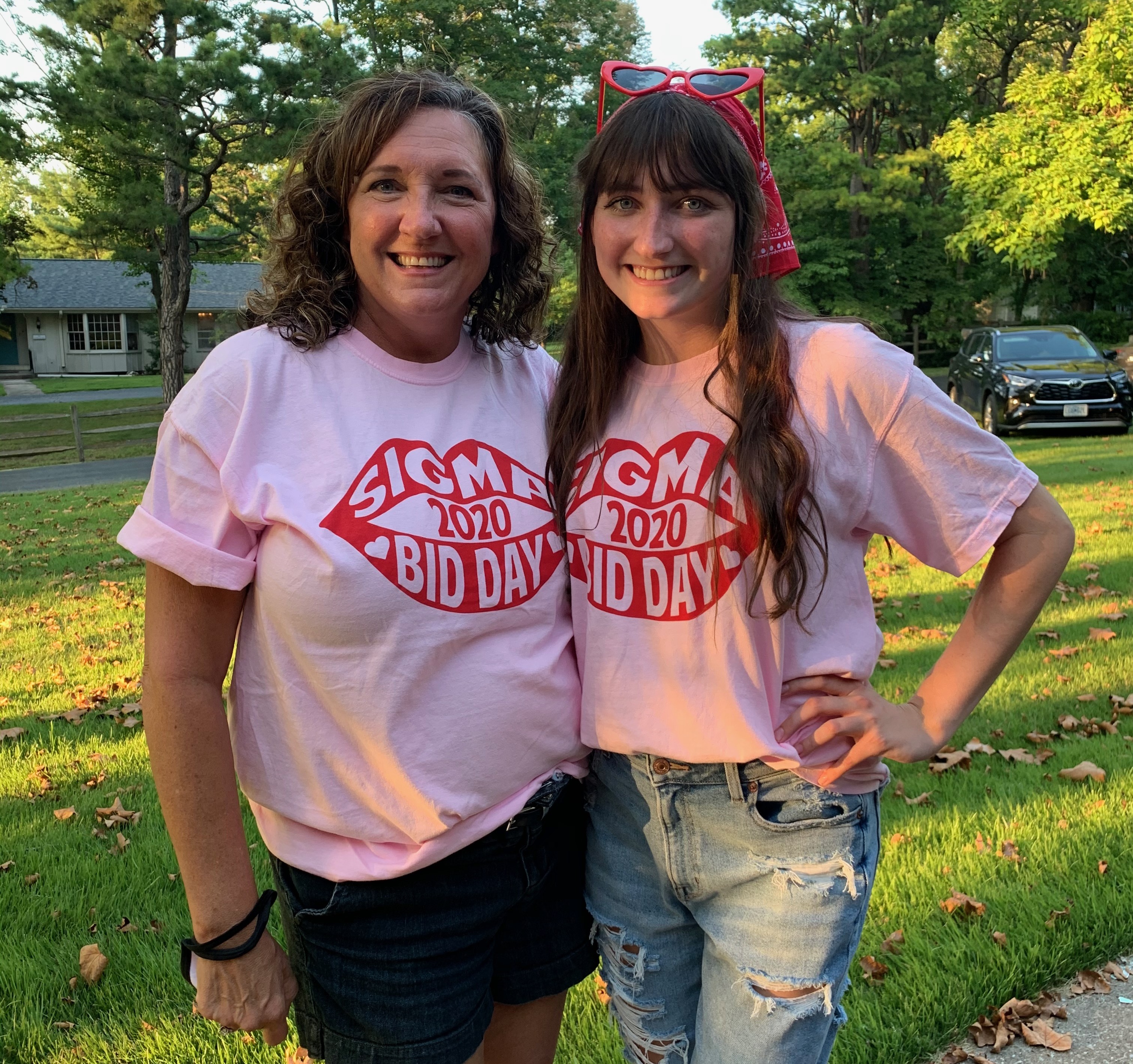
Kristina Schuler, '90, and her daughter, Kate, '21, share UCM as their alma mater and Tri Sigma as their sorority family. Kristina's husband, Kurtis, '89, and their son, Kaleb, '18, are alumni of the same fraternity, Alpha Kappa Lambda.
Townie Tradition
Ellen Blaize, ’11, ’13, and her brother, Timothy Becker, ’19, grew up in Warrensburg. As children, they frequently attended UCM events, including sports games and theater productions. As with so many other UCM Legacy Families, Homecoming for them is a cherished tradition. Their mother, Debbie Becker, ’76, claims not to have missed a UCM Homecoming in the past 50 years.
Ellen, who serves as UCM’s senior integrated marketing specialist, is proud that her family’s legacy spans generations: one for each of the five names the university has had, starting with State Normal School No. 2. Theirs is a story shaped both by student life and the real-world moments that unfolded beyond campus. Her great-grandmother, Myrtle Pitchford, ’13, was on campus when the Titanic sank. Her grandfather, David Becker, ’46, was a student when World War II ended. And her dad, James Becker, ’75, ’76, was just starting college when The Beatles broke up.
“I think the next generations keep coming back to UCM because it’s tried and true,” James says. “The family knows that it works; it’s a good place to be, and it’ll set you up for a good future.”
Kevin Smarr, ’06, also has a long UCM Family Legacy. The Smarr family has lived in Warrensburg since 1880, and their legacy spans six generations. When Kevin’s parents, Rex, ’75, and Adrienne, ’71, Smarr attended the university as married students, they shared a house on South College Street, which turned into Kevin’s childhood home.
He spent his youth playing basketball, riding bikes on campus with friends and playing tennis at the Ellis courts.
“I went to all of the basketball games — my grandfather had season tickets, and I’ve been going ever since I was a kid,” Kevin says. “We have courtside seats now, and I take my kids.”
He is passing on more traditions than just attending basketball games, though. His family’s Homecoming tradition was a little different from most. Every year after the Homecoming parade, the UCM Marching Mules would stop in front of the Smarrs’ childhood home to give a private concert. To this day, Kevin gives back to UCM Bands with an annual donation in honor of his grandfather, Edwin Ellis, who was a band judge.
By the time Kevin was ready to make his college decision, UCM already felt like a natural next step. He ended up joining Alpha Tau Omega, the fraternity next door to his childhood home, and making lifelong friends. He keeps in touch with college friends through the MuleNation Home Chapter, a group for alumni in the Warrensburg area, and has served as a chapter leader for seven years.
Lucinda Harris, ’96, ’04, ’24, also grew up in Warrensburg but felt the pull to leave her hometown after graduating from high school. It didn’t take long, however, for her to miss the community and campus that had long been part of her life. She transferred back home, creating a new branch to an already deeply rooted UCM Family Legacy.
“Every major event I’ve had in my life seems to have been on this campus,” Lucinda says. “Whether that was prom in the student union or graduation in the Multi … I have walked that stage four times.”
Both of her daughters — Lanelle Cole, ’23, and Liberty Cole, who is entering her senior year at UCM — did the same thing. They each began their collegiate journeys at other universities before realizing that UCM was the right choice to build the strongest foundation for their future.
“There’s something about being a Mule here at UCM that just brings everyone together, and you just want to keep going,” Liberty explains.
Their family legacy spans five generations to the early 1900s, and Liberty is following in her great-grandfather’s footsteps as a Chemistry major. Billy P. Mudd, ’53, taught science at CMSC’s lab school, then later taught chemistry and supervised student teachers at CMSU.
“I’m continuing the legacy while building my own at the same time,” Liberty says.
While these families all have deep roots in Warrensburg, some UCM Legacy stories begin with an individual’s decision to start their journey at UCM.
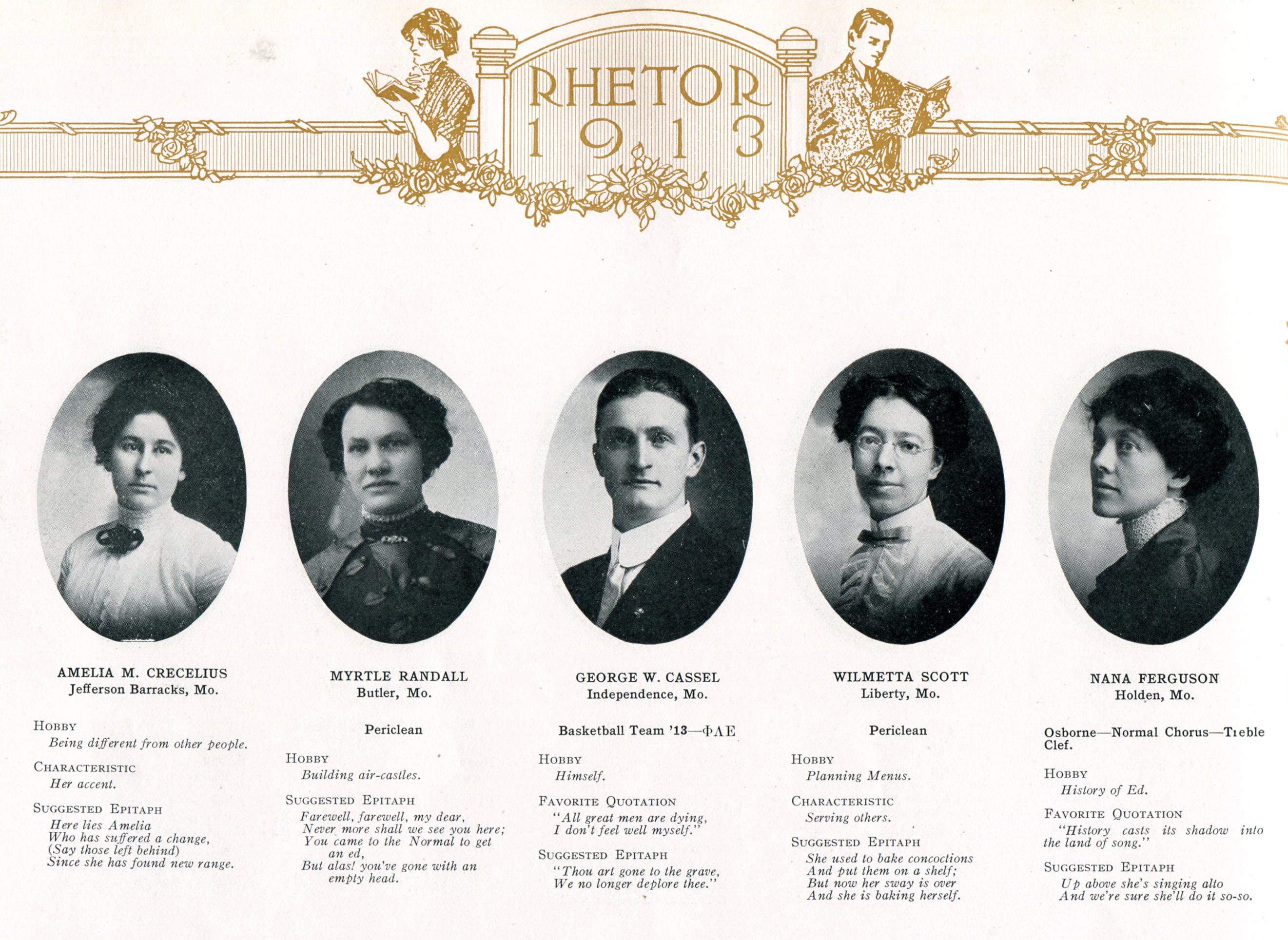
Two-time alumna Ellen Blaize, '11, '13, has a UCM Legacy Family dating back to 1913, when her great-grandmother, Myrtle (Randall) Pitchford, graduated from what was then State Normal School No. 2.
Nontraditional Legacy
John T. Hightower Jr., ’07, came to UCM when his daughters were young — not as a student but as a business owner. He tells the story about traveling to Warrensburg to talk with then-President Aaron Podolefsky about possibilities for collaboration with a nonprofit he had launched to bring aviation opportunities to underrepresented youth in the Kansas City metropolitan area. The president was so excited that he marched John to the Admissions Office and enrolled him that day in a master’s program in Aviation Safety before John could even finish his presentation.
John’s UCM Legacy started with a decision he made as an adult, which then influenced his two daughters’ higher education decisions. His oldest daughter, Johnae Hightower, ’23, earned a degree from UCM in Sports Management. Gabrielle “Gabbie” Hightower will graduate with a degree in Fashion Merchandising in May 2027.
“My dad set the expectation of having a quality education and striving to do your best,” Gabbie says, remembering how she and her sister would watch their dad study at home.
John is proud that his daughters have followed in his footsteps at UCM.
“It is a continuation,” he beams. “For that legacy to continue and to see the investment that I made as a young man, to see that my daughters are seeing the give back, it’s a blessing.”
There are many children who see their parents go to UCM and decide it’s also the place for them. Crissy Hall, ’16, is another example of a parent who pursued a master’s as an adult student.
While working as a registered nurse, Crissy enrolled in a Master of Science program in Rural Family Nursing. As a single parent of three daughters, she was looking for a program that was affordable and that worked with her already busy schedule.
“I could take as many classes as I wanted, or I could take as few as I wanted while I was working full time and trying to raise my kids,” she recalls. “I really liked the flexibility that UCM offered.”
She began doing clinicals at UCM in 2014 and continued working in the UCM Health Center as needed after graduation. In 2021, she became the clinical director of the University Health Center.
Crissy’s oldest daughter, Ashton, was the first to follow her mother to UCM in 2019, and Noelle enrolled in 2021. Ashton graduated in 2022 with a degree in Economics, and Noelle graduated in May 2026 with a bachelor’s in Communications. Now the youngest sister, Hayden, is entering her junior year as an Occupational Safety and Health major.
“Being able to be with both of my sisters at the same time has been really special and something I’m going to remember for the rest of my life,” Noelle reflects.
When it was finally Hayden’s turn to become a Jenny, she already knew what to expect. She had experienced university traditions with her UCM Legacy Family and joined Gamma Phi Beta.
“The campus is very welcoming,” Hayden shares. “When I was a freshman, I didn’t have too many friends coming into college. I ended up joining my sorority, and I met a lot of people I wouldn’t have gotten to meet.”
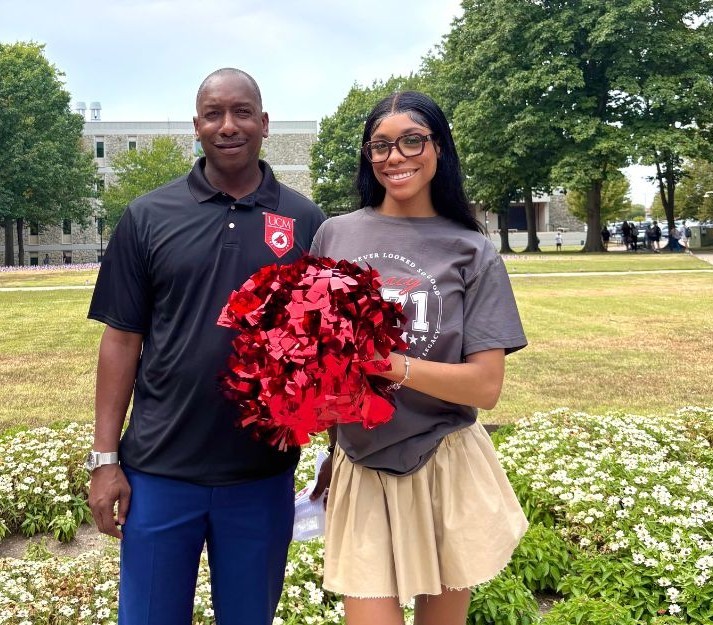
John Hightower was the first in his family to attend UCM, and his daughter Gabbie is following in his footsteps as a student in the Fashion Merchandising program that designed the UCM Legacy line of clothing. His other daughter, Johnae, graduated in 2023.
Once a Mule, Always a Mule
At UCM, CMSU or any other name, for generations families have found their home at the university. The name may change and the campus may evolve, but the spirit of community remains.
“It just has that family feel, and I don’t think that has changed at all,” Kristina Schuler says.
What you get out of being a UCM Legacy Family isn’t always tangible — it’s not something you hold in your hand, but rather in your heart.
Are you part of a UCM Legacy Family? Tell us your story, share a family photo and learn about the Alumni Legacy Scholarship.
UCM Legacy Program